I grew up in Uganda. I have spent my entire career guiding travelers through its forests, wetlands, and savannahs. And yet, every single time a client spots their first shoebill stork rising out of a papyrus swamp at dawn, that ancient silhouette hanging in the morning mist, I still feel exactly what they feel.
Absolute disbelief that this bird actually exists.
Uganda does not get the attention it deserves on the global birdwatching circuit. Most North American and European travelers still default to Kenya or Tanzania when planning an East Africa safari. That is understandable; those are extraordinary destinations. But for birds? Uganda is in a different category entirely. We have over 1,060 recorded species packed into a country roughly the size of the UK, including some of the rarest, most visually extraordinary birds on the planet.
So, what rare bird can be found in Uganda? Let me show you.

Explore Uganda’s Rare Birds with Expert Birding Safaris
At Valiant Safaris, we design birdwatching experiences specifically for travelers who want more than a tick on a checklist. Whether you are a serious lister targeting Albertine Rift endemics, a wildlife photographer chasing the perfect shoebill frame, or a first-time visitor who simply wants to stand three meters from a prehistoric-looking bird and quietly lose your composure, we build the safari around you.
What we offer for birding travelers:
- Shoebill tracking experiences at Mabamba Swamp and the Albert Delta in Murchison Falls
- Specialist forest birding tours through Bwindi, Kibale, and Budongo
- Guided nature walks with expert local birding guides, not generalist game drive guides. This distinction matters enormously, and I’ll explain why later.
- Photography-focused safaris with dawn starts, optimal positioning, and specialist photographic guidance
- Combined gorilla trekking + birdwatching itineraries, Uganda’s most rewarding dual wildlife experience
Plan Your Uganda Birding Safari
Contact: Email | WhatsApp: +256-704-613919 | Response within 24 hours
Share your target species list, travel dates, and budget. We will design a custom itinerary and confirm availability within 48 hours.
Why Uganda Is One of Africa’s Best Birdwatching Destinations
Here is what I tell every client who asks whether Uganda is really better than Kenya for birdwatching:
Uganda has more bird species per square kilometer than almost any country in Africa. Including Kenya.
Over 1,060 species. More than the entire continent of Europe. And crucially, many of them are species that cannot be seen anywhere else on Earth.
The Albertine Rift, Africa’s Greatest Biodiversity Hotspot
Uganda sits within the Albertine Rift, the most biologically diverse region on the African continent. This ancient geological rift stretches along Uganda’s western border through Rwanda, DRC, Burundi, and western Tanzania. The montane forests on either side have evolved in relative isolation over millions of years, producing 39 endemic bird species found absolutely nowhere else on the planet.
Thirty-nine. In one country.
When I take a client from London or Toronto into Bwindi’s Ruhija sector for the first time, the species they encounter in a single morning are simply not accessible on any other continent’s birding circuit. That exclusivity is what makes Uganda genuinely world-class for serious listers.
Habitat Diversity: Covering Every Base
From papyrus swamps on Lake Victoria to equatorial rainforest, highland montane forest, savannah grassland, and Great Lakes shoreline, Uganda compresses an extraordinary range of ecosystems into a compact, traveler-friendly geography. Each habitat supports entirely different bird communities. A 10-day Uganda birding circuit can move through four distinct ecosystem types without covering more than a few hundred kilometers.
Fewer Crowds Than You Would Expect

Mabamba Swamp, the best shoebill location in Africa, sees a fraction of the visitor traffic that Kenya’s Rift Valley Lakes attract. I have done shoebill excursions there where my clients had the bird completely to themselves for forty minutes. That level of intimacy simply does not happen at the famous birding sites in Kenya or Tanzania.
What Rare Bird Can Be Found in Uganda?
Let me walk you through the birds that make clients fly specifically from New York, London, and Sydney to visit Uganda.
Shoebill Stork (Balaeniceps rex)
Uganda’s most famous rare bird, and one of the most extraordinary animals on the planet.
I have been guiding safaris since 2012 and I have never once become bored of watching a client see their first shoebill. The reaction is always the same: silence, then a whispered oath, then the frantic adjustment of camera settings. This bird does something to people.
The shoebill stands up to 1.4 meters tall. It is slate-grey, motionless for minutes at a time, and equipped with a massive hooked bill that looks like it was engineered by someone who had never seen a bird before. It hunts lungfish and catfish in dense papyrus swamps with extraordinary patience, holding absolutely still before striking with speed that catches you completely off guard.
Uganda holds the largest accessible population of shoebill storks in East Africa. If seeing this bird is on your list, and for most serious wildlife travelers, it is near the top, Uganda is the place.
Where to see it: Mabamba Swamp on Lake Victoria (45 minutes from Entebbe) is the gold standard. A canoe into the papyrus channels at dawn typically produces sightings within the first hour. Murchison Falls National Park’s Albert Delta is the reliable second location, accessed by morning boat safari.
IUCN Status: Vulnerable. Global population: approximately 5,000–8,000 individuals.
Green-Breasted Pitta (Pitta reichenowi)
If the shoebill is Uganda’s headline act, the green-breasted pitta is the rare bonus track that dedicated birders travel specifically to find.
This is a small, jewel-colored ground bird, with an iridescent green breast, scarlet belly, and vivid blue wing flashes, that moves quickly through dense rainforest undergrowth and is heard far more often than it is seen. I have guided clients who spent three days in Kibale Forest solely for this species. When they finally see it, the silence that follows is different from the shoebill silence. It is quieter. More reverent.
Early morning is essential, the first two hours after sunrise, when the pitta is most vocal and most active. A specialist local guide who knows specific territories within your forest sector makes all the difference between a confirmed sighting and a frustrating near-miss.
Where to see it: Bwindi Impenetrable National Park, Kibale Forest National Park, Semuliki National Park.
African Green Broadbill (Pseudocalyptomena graueri)
This bird makes experienced African birders nervous just thinking about it.
A tiny, entirely green Albertine Rift endemic, restricted to a narrow elevation band of montane forest between 1,600 and 2,500 meters, primarily in Bwindi and adjacent DRC. Its camouflage against forest vegetation is near-perfect. The population is small. Its territory is highly specific. Without a local guide who knows individual birds in particular forest sectors, the chances of finding them independently approach zero.
With the right guide? It becomes one of the most quietly triumphant moments of any Uganda birding trip.
Where to see it: Bwindi Impenetrable Forest, the Ruhija sector specifically, offers the most reliable access. IUCN Status: Vulnerable.
Shelley’s Crimsonwing (Cryptospiza shelleyi)
A secretive high-altitude finch that ranks among the most coveted ticks on any East African birding list. The male’s deep crimson plumage is genuinely striking when you catch a clear view, but the bird forages in dense vegetation, and encounters are brief, unpredictable, and memorable precisely because of it.
Uganda’s Rwenzori Mountains and Bwindi’s higher sectors are the most accessible locations for this Albertine Rift endemic. I have had clients who listed this as their single most-wanted East African bird, and Uganda delivered.
Where to see it: Rwenzori Mountains National Park, Bwindi Impenetrable Forest (Ruhija sector).
Fox’s Weaver (Ploceus spekeoides)
Uganda’s only true national endemic, found nowhere else on the planet. It is not the most visually spectacular bird on this list, but its complete exclusivity to Uganda makes it a mandatory target for any serious lister visiting the country. Ticking Uganda’s only national endemic carries its own particular satisfaction that I have watched clients genuinely celebrate.
Fox’s weaver inhabits papyrus swamps and adjacent woodland in northern and eastern Uganda.
Where to see it: Lake Bisina and Lake Opeta wetlands in eastern Uganda, occasionally around Murchison Falls.
Grauer’s Rush Warbler (Bradypterus graueri)
The rarest resident bird in Uganda, and one of the most threatened species in Africa. Critically endangered. A tiny Albertine Rift endemic confined to montane papyrus and sedge swamps above 1,900 meters. Its specialized habitat is shrinking under agricultural pressure, and its global population is counted in the hundreds.
Uganda’s Bwindi and Rwenzori regions represent one of the last stable populations of this species. This is a bird for specialist birders with patience, a guide who knows the territory, and a genuine appreciation for what they are looking at.
IUCN Status: Critically Endangered.
Top Rare Birds to See in Uganda: Extended List
Beyond the headline species, Uganda’s birdwatching rewards depth of exploration. Here are more birds that regularly feature on my clients’ most-wanted lists:
| Bird | Habitat | Rarity / Status |
| Shoebill Stork | Papyrus swamps | Globally Vulnerable |
| Great Blue Turaco | Rainforest canopy | Uncommon, Albertine endemic |
| Nahan’s Francolin | Dense forest floor | Vulnerable, elusive |
| Doherty’s Bushshrike | Montane forest | Albertine Rift endemic |
| Handsome Spurfowl | Highland forest edges | Albertine Rift endemic |
| Rwenzori Turaco | Montane forest | Endemic to Rwenzoris |
| Chapin’s Flycatcher | Forest interior | Rare Albertine endemic |
| African Skimmer | River sandbanks | Uncommon, seasonal |
| Papyrus Gonolek | Papyrus swamps | Near-endemic to region |
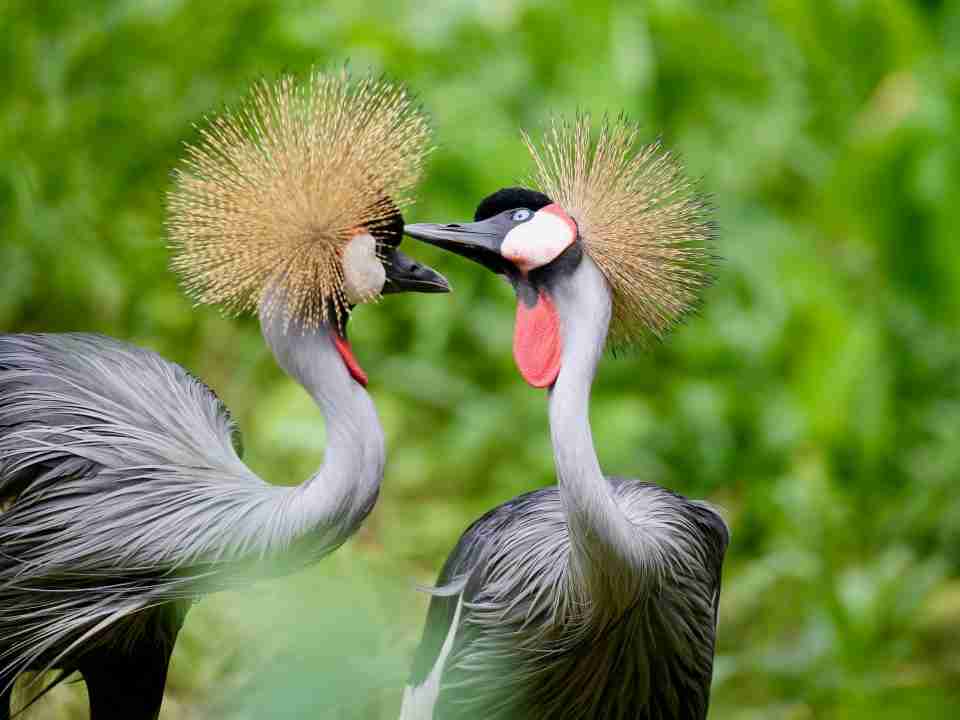
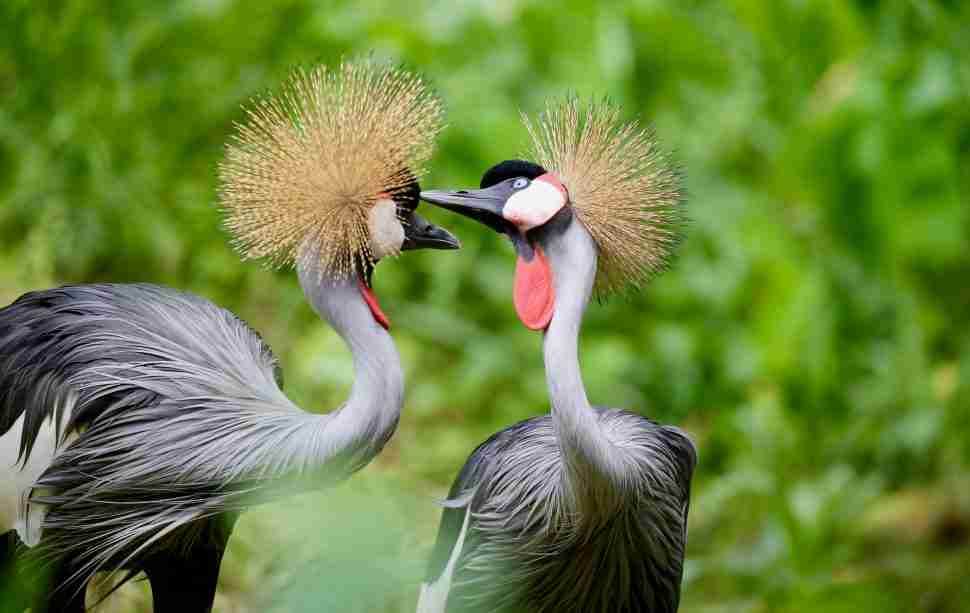
| Grey-Crowned Crane | Open wetlands | Uganda’s national bird, Near Threatened globally |
| African Grey Parrot | Rainforest | Locally scarce, Kibale and Budongo |

Best Places for Birdwatching in Uganda
Mabamba Swamp, Shoebill Capital of East Africa
This is where I take clients who have one day in Uganda and want to see something they will never forget. Mabamba sits on the northwestern shore of Lake Victoria, 45 minutes from Entebbe International Airport. Local canoe guides navigate narrow papyrus channels at dawn, reading water signs and listening for feeding activity.
Most visits produce extended, close sightings. I have had clients within four meters of a feeding shoebill, close enough to hear the water move when it strikes. There is no zoo equivalent to this experience.
Target species: Shoebill stork, blue-breasted bee-eater, white-winged warbler, papyrus gonolek, African jacana, malachite kingfisher, lesser jacana.
Practical tip: Mabamba works perfectly as a pre-departure excursion on your final Uganda morning, or as a first-day orientation experience after arriving at Entebbe. It adds genuine world-class wildlife value to any itinerary at minimal time cost.
Bwindi Impenetrable Forest, Albertine Rift Endemic Headquarters
Most of my international clients come to Bwindi for the gorillas. What surprises many of them is discovering that the forest they trekked through for their gorilla encounter is simultaneously one of the most important endemic bird forests in Africa.
Over 350 bird species. Twenty-three Albertine Rift endemics. The highest concentration of endemic birds in any single forest on the continent.
Target species: African green broadbill, green-breasted pitta, Shelley’s crimsonwing, Grauer’s rush warbler, Rwenzori batis, black-faced rufous warbler, Kivu ground thrush, handsome spurfowl, stripe-breasted tit.
Best sectors for birding: Ruhija for endemic density, the highest altitude sector with the most target species per morning walk. Buhoma for general forest birding and accessibility.
See our gorilla trekking Uganda guide for how to build a combined gorilla and birding itinerary. This is one of the most rewarding combinations I design, and I do it regularly for UK and US clients who want genuine depth from their Uganda safari.
Queen Elizabeth National Park, 600 Species in One Park
Uganda’s most ecologically diverse protected area sits at the intersection of savannah, rainforest, and Great Lakes wetland, producing over 600 bird species within a single park. That number is remarkable by any global standard.
The Kazinga Channel boat safari is among the most productive two hours of birding I know anywhere in Africa. Hippos, crocodiles, and elephants in the background, while pelicans, skimmers, kingfishers, herons, and species you haven’t thought to expect appear at close range along the banks.
Target species: Shoebill stork (Albert Delta area), African skimmer, martial eagle, verreaux’s eagle owl, white-tailed lark, pink-backed pelican, saddle-billed stork, papyrus canary.
See our Queen Elizabeth National Park safari packages for itineraries combining wildlife game drives with dedicated birding.
Kibale Forest National Park, Where Primates and Forest Birds Meet
Kibale is on most visitors’ radar for chimpanzee trekking. My birding clients know it as one of Uganda’s finest tropical forest birding environments, home to species that simply do not appear in the drier forests to the east or south.
Target species: Green-breasted pitta, African pitta, Nahan’s francolin, yellow-spotted nicator, purple-breasted sunbird, African grey parrot, black bee-eater, little greenbul.
See our chimpanzee trekking Uganda guide for itineraries that combine morning chimp tracking with afternoon forest birding walks, two activities that share the same forest and complement each other perfectly.
Murchison Falls National Park, Waterway Giants, and Savannah Species
Uganda’s largest park offers two completely different birding environments in one destination. The northern savannah produces classic open-country East African species. The Nile River corridor below the falls, specifically the morning boat trip to the base, is exceptional for waterbirds and one of the most reliable secondary shoebill locations in Uganda.
Target species: Shoebill stork (Albert Delta), goliath heron, Abyssinian ground hornbill, Abyssinian roller, swallow-tailed bee-eater, Denham’s bustard, standard-winged nightjar, black-headed gonolek.
Uganda’s Endemic and Albertine Rift Bird Species
I want to spend a moment on why the Albertine Rift matters, because it is the single most important thing to understand about Uganda’s global birding significance.
What is an endemic species?
An endemic bird is one found in a specific region and nowhere else on Earth. Uganda has one true national endemic, Fox’s weaver. Within the broader Albertine Rift biodiversity hotspot, Uganda protects 39 endemic species shared across the rift’s narrow corridor of montane forests.
Why this matters for your safari:
The species you see on the slopes of Bwindi or in the Rwenzori Mountains cannot be seen in South Africa. Mountain gorillas are not found on a typical Kenya safari. The Serengeti is also outside their natural range. Hidden within a narrow corridor of Central African montane forest, these remarkable primates are most easily accessed through Uganda, which provides the best-guided gorilla trekking experience in the world.
A dedicated 10-day Uganda birding safari targeting Albertine Rift endemics can realistically produce sightings of 20–30 endemic species. That competes favorably with any specialized birding destination in Africa.
Uganda vs. Kenya and Tanzania for Birdwatching
I get this comparison question regularly from clients researching East Africa destinations. Here is my honest assessment, as someone who has guided in all three countries:
| Feature | Uganda | Kenya | Tanzania |
| Total species | 1,060+ | 1,100+ | 1,050+ |
| Albertine Rift endemics accessible | 39 | 0 | Very few |
| Shoebill stork access | Excellent | Rare | Very rare |
| Forest birding quality | Outstanding | Moderate | Good |
| Crowd levels at birding sites | Low | High | Moderate |
| Gorilla + birding combination | Yes | No | No |
| Best for endemic species | ⭐⭐⭐⭐⭐ | ⭐⭐ | ⭐⭐⭐ |
| Value for specialist birding | ⭐⭐⭐⭐⭐ | ⭐⭐⭐ | ⭐⭐⭐ |
My honest recommendation: for forest endemics, shoebill stork, and Albertine Rift species, Uganda is the clear answer. Kenya’s advantage is Rift Valley waterbirds and open savannah species boosted by Palearctic migrants. The most comprehensive East Africa birding itinerary combines Uganda with Kenya, something we design regularly through our East Africa safari packages.
Best Time to See Rare Birds in Uganda
Uganda produces rewarding birdwatching every month of the year. But timing affects visibility, species availability, and physical comfort:
June–August (Main Dry Season): Best Overall. Reduced vegetation improves visibility dramatically. Trails are dry and accessible. Shoebills at Mabamba concentrate in feeding areas and allow a closer canoe approach. Resident species are in breeding plumage. This aligns with peak gorilla trekking season, ideal timing for a combined birding and gorilla itinerary.
December–February (Short Dry Season), Excellent for Species Counts. Palearctic migratory species are present from November through March, adding significantly to daily species tallies. Forest birds are active and vocal. Gorilla permits are more accessible than during peak season. Lodge prices are lower. This is genuinely my second-favorite period for Uganda birding.
March–May (Green Season), For Dedicated Specialists. Heavy rainfall makes some forest trails challenging and certain roads difficult. But lush conditions bring forest birds into high activity, display behavior is frequent, species are vocal, and visitor numbers drop to near-zero. For clients comfortable with mud and unpredictable weather, this period offers exceptional photography and virtually private sightings.
One thing I emphasize to every birding client: daily timing matters more than most people realize. Be at Mabamba’s canoe launch by 6:00 AM. Be on Bwindi’s forest trails by 6:30 AM. The two hours after sunrise are disproportionately productive, more rewarding in most cases than entire afternoons combined.
Uganda Birdwatching Safari Costs
Every itinerary at Valiant Safaris is custom-designed, but here is an honest framework for budgeting your Uganda birding safari:
| Package | Duration | Price Per Person | What’s Included |
| Budget Birding | 5–7 days | $1,200–$2,500 | Basic lodges, specialist guide, key birding sites |
| Mid-Range Birding ⭐ | 7–10 days | $2,500–$4,500 | Comfortable en-suite lodges, private specialist guide, all major sites |
| Luxury Birding | 10–14 days | $4,500–$8,000+ | Premium lodges, private photography-specialist guide, full endemic circuit |
| Gorilla + Birding Combo | 10–12 days | $4,000–$9,000 | Gorilla permit ($800) + full Uganda birding circuit |
All packages include a specialist birding guide, private ground transportation, park entrance fees, and accommodation. International flights and travel insurance are additional.
One thing I always say to birding clients: the most important investment in a Uganda birding safari is not the lodge tier, it is the quality of your guide. A specialist who knows Bwindi’s Ruhija sector intimately, or who reads Mabamba’s papyrus channels the way a good fisherman reads water, will produce sightings a generalist guide simply cannot. We use specialist birding guides exclusively on our birding tours.
Get a Custom Birding Safari Quote
Contact: Email | WhatsApp: +256-704-613919 | Response within 24 hours
Tell us your target species list. We will build the itinerary around what you most want to see.
Tips for Birdwatching in Uganda
After organizing hundreds of birding excursions across Uganda, here is the practical advice I give every client before they arrive:
Bring quality binoculars; 8×42 is the sweet spot for forest birding. Forest birding means fleeting views in variable light through dense vegetation. Quality optics are not a luxury; they are the difference between a confirmed sighting and a frustrating silhouette. I recommend 8×42 for their balance of magnification and light-gathering in forest conditions.
Wear neutral clothing, khaki, olive, or brown only. Bright colors, white, and blue alert birds and reduce your approach distance significantly in forest environments. This is not an aesthetic preference; it materially affects how close you get to target species.
Hire a specialist birding guide, not a general safari guide. I cannot overstate this point. Uganda has outstanding specialist birding guides who know individual bird territories, vocalizations, and daily behavioral patterns across specific forest sectors. The difference between a specialist and a generalist guide is not marginal. It is transformative.
Camera with 400mm+ lens and high ISO capability. Shoebill and open-water birds can be photographed well at 300–400mm. Dense forest species like the green-breasted pitta require 400–600mm and a camera body that performs cleanly at ISO 3200 or above. Bwindi’s forest interior is genuinely low-light; plan for it.
Be on site at dawn, without exception. The first two hours after sunrise produce a disproportionate share of the day’s best sightings. Clients who push their start time back by ninety minutes regularly miss the species they traveled for.
Move slowly, stop often, listen before looking. Most rare forest species in Uganda are heard before they are seen. Walk slowly, pause frequently, and listen actively. The clients who find the most species are consistently the ones who slow down.
Who Should Visit Uganda for Birdwatching?
Serious birders targeting African lifers: Uganda’s 39 accessible Albertine Rift endemics represent one of the most concentrated lifer opportunities available anywhere in Africa. A 10-day specialist circuit can realistically add 400–500 species to a life list, including multiple species that are simply not accessible anywhere else.
Wildlife photographers: The shoebill stork alone justifies a Uganda trip for any serious wildlife photographer. The combination of approachable rare species, dramatic forest settings, and exceptional photographic intimacy, particularly on Mabamba’s canoe approach, makes Uganda outstanding for portfolio-level imagery.
Mid-range and luxury safari travelers adding depth to their itinerary: Every Bwindi gorilla itinerary passes through prime Albertine Rift bird territory. Every Murchison Falls visit includes the Albert Delta boat trip where shoebills regularly appear. Adding dedicated birding walks to any Uganda safari requires minimal additional time and delivers extraordinary additional value.
First-time Africa visitors who want something beyond the standard circuit: If you have done Kenya and Tanzania and want the Africa that most tourists miss, ancient forest endemics, papyrus wetland giants, birds that exist nowhere else on Earth, Uganda is where you come next.
Frequently Asked Questions
What is the rarest bird in Uganda?
Grauer’s rush warbler is Uganda’s rarest resident, a critically endangered Albertine Rift endemic with a global population counted in the hundreds. For international visitors, the shoebill stork is the most sought-after species due to its iconic appearance and the fact that Uganda offers the world’s most reliable access to it.
Where can I see a shoebill stork in Uganda?
Mabamba Swamp on Lake Victoria (45 minutes from Entebbe) is the most reliable shoebill location in Africa, accessible by canoe at dawn. The Albert Delta in Murchison Falls National Park is the second-best location, accessed by morning boat safari, and on the Semliki Wildlife Reserve on Lake Albert, also accessible by boat.
How many bird species are in Uganda?
Uganda has over 1,060 recorded species, including 39 Albertine Rift endemics and one true national endemic (Fox’s weaver). Uganda consistently ranks among Africa’s top five birdwatching destinations by species density.
Is Uganda good for birdwatching?
Exceptional. For forest birds, Albertine Rift endemics, and the shoebill stork specifically, Uganda offers better access than any other country in East Africa. It is a first-choice destination for specialist birders, not a backup option.
What is the best time for birding in Uganda?
June–August and December–February are optimal. Uganda produces excellent birdwatching year-round; no month is genuinely poor for resident species.
Can I combine birdwatching with gorilla trekking?
Absolutely, and this is one of my most-requested itinerary combinations. Bwindi Impenetrable Forest is simultaneously one of the world’s great gorilla habitats and one of Africa’s most important endemic bird forests. Gorilla trekking days combine naturally with dedicated birding walks in the same forest.
Plan Your Uganda Birdwatching Safari Today
Uganda is not a consolation destination for travelers who couldn’t get to more famous East African locations. It is a first-choice destination for anyone who takes African wildlife seriously.
Since 2012, I have been guiding visitors across Uganda’s diverse wildlife destinations. Over the years, travelers from New York, London, and Amsterdam have stepped off a canoe at Mabamba visibly moved after spending just forty minutes with a bird that seems straight out of the Cretaceous period. In Bwindi, even seasoned birders with life lists exceeding 3,000 species often fall silent when they finally spot the elusive African green broadbill.
Uganda does this to people. Reliably. Every time.
Tell me your target species. I will build the safari around them.
Contact: Email | WhatsApp: +256-704-613919 | Response within 24 hours
12+ years organizing Uganda Birding and wildlife safaris. Direct Uganda Wildlife Authority permit procurement. Specialist birding guides on every birding tour.

About the Author
Joseph Wejuli was born in Uganda and grew up visiting Uganda’s national parks. After studying tourism management at Makerere University, he spent a decade working with top safari operators before joining Valiant Safaris in 2017. He has personally organized over 400 gorilla treks and dozens of specialist birding safaris across Uganda. Joseph specializes in designing itineraries for North American and European travelers and takes particular pride in showing visitors the Uganda that most tourists never see, the dawn papyrus swamps, the hidden forest endemics, the quiet moments that never appear in the brochures.
Contact: Email | WhatsApp: +256-704-613919 | Response within 24 hours
Article last updated: June 2026. Bird species counts per Uganda Bird Records Committee (UBRC). All prices verified with Uganda Wildlife Authority.

Senior Safari Planner, Valiant Safaris
Joseph grew up in Uganda, with the country’s national parks woven into his childhood. That early connection to the wild set the course for a career now spanning nearly two decades in East African tourism.
After completing his degree in Tourism Management at Makerere University, Joseph spent a decade with several of Uganda’s leading tour operators, building an intimate knowledge of the region’s parks, wildlife, and cultures long before he joined Valiant Safaris in 2017. In the years since, he has personally planned more than 400 gorilla treks experience spanning every budget tier, with particular expertise in curating polished, thoughtful journeys for luxury and top mid-range travelers from North America, Europe and the rest of the world.
As Senior Safari Planner, Joseph specializes in gorilla trekking, wildlife safaris, authentic cultural encounters, and farm & community tours, alongside adventure and sustainable travel experiences across Uganda, Rwanda, Tanzania, Kenya, Burundi, and the Democratic Republic of Congo. His approach favors depth over checklist tourism, taking travelers beyond the well-worn trail to the East Africa most visitors never get to see.
For guests planning a safari with Joseph, the result is more than a well-organized trip. It’s a journey shaped by someone who has spent a lifetime learning this land.