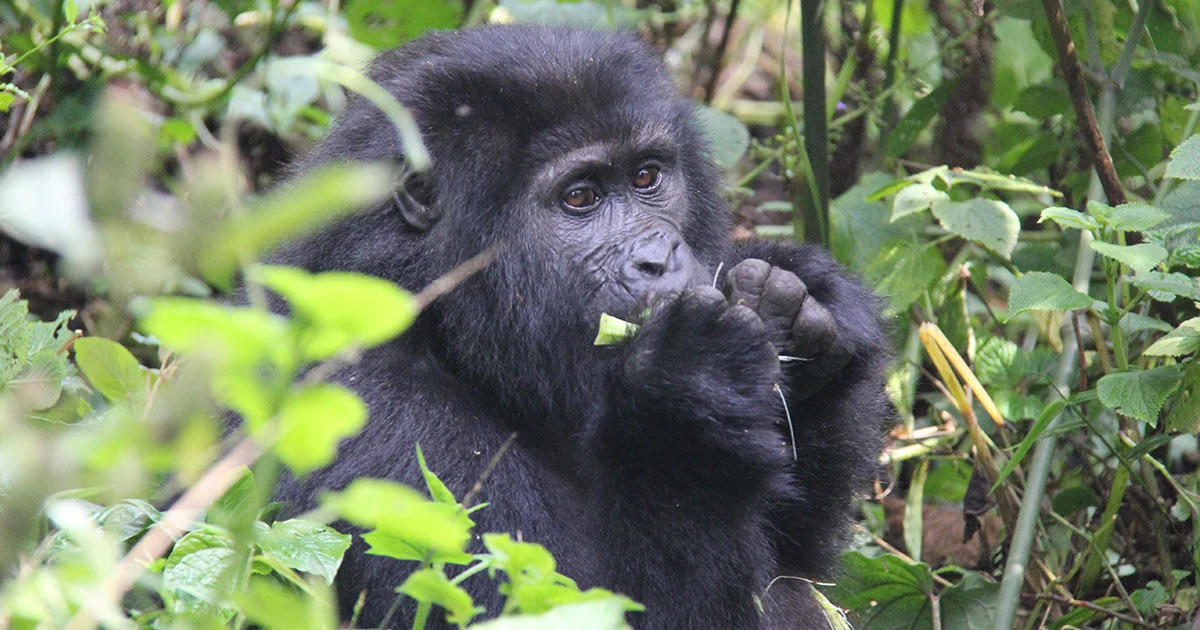
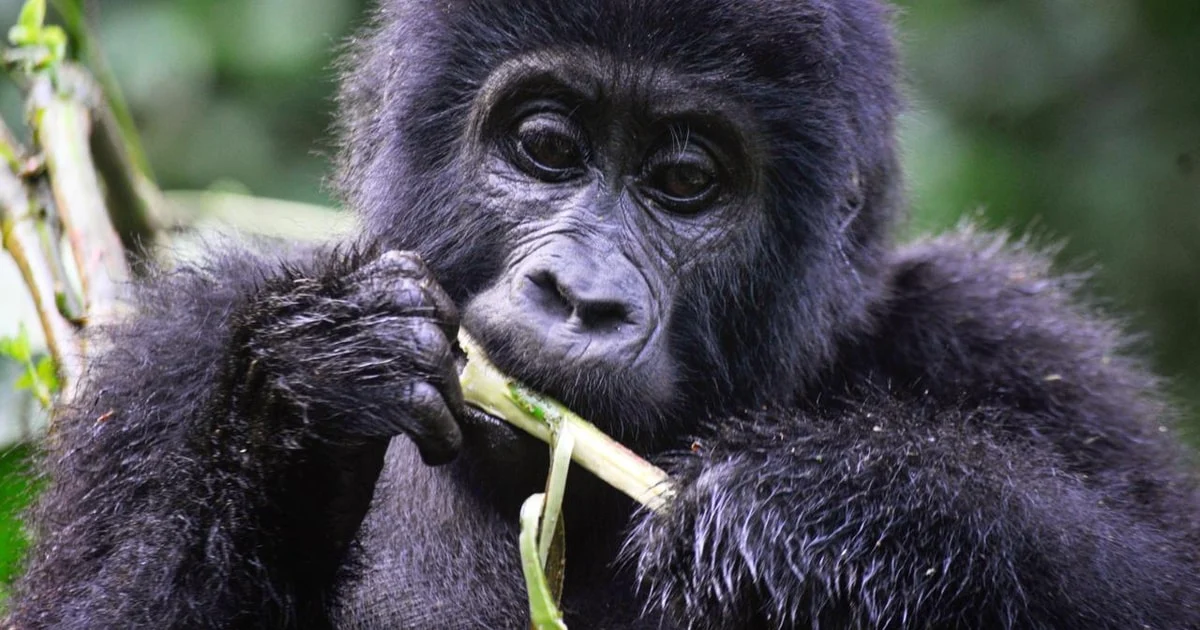
Let me show you where does Mountain Gorillas Live. “I still remember the first time I saw mountain gorillas in Bwindi, the mist, the silent forest, the gentle rustling of leaves above me. They live in these forests not just by biology, but by ancient rhythm. Standing a few feet from a silverback that morning, I understood something I couldn’t quite explain before: these mountains are not just their home. They are part of who they are.”, Joseph Wejuli
I get this question almost every week from clients planning their first African safari: where does mountain gorillas live? It’s one of those questions that sounds simple, but the answer opens a door to one of the most extraordinary wildlife stories on the planet.
Mountain gorillas do not live just anywhere across Africa’s vast and diverse landscapes and forest ecosystems today. They occupy one of the most specific and restricted ranges of any great ape species in Africa. Their habitat consists of cloud-draped mountain forests straddling Uganda, Rwanda, and the Democratic Republic of Congo. Understanding exactly where they live and why they thrive there is essential for planning a meaningful safari. This knowledge forms the first step toward creating a safari experience that genuinely changes your life. In this guide, I will explain everything you need to know about mountain gorilla habitat. You will learn about their forest ecosystem, the best national parks to visit, and ideal trekking seasons. I will also explain how to plan a responsible, luxury safari experience with Valiant Safaris. Whether you are a wildlife enthusiast, a first-time Africa traveller, or a seasoned adventurer, this guide helps. If you seek your next great journey in Africa, this comprehensive guide is designed for you.
What Are Mountain Gorillas?
Before we explore where mountain gorillas live, it helps to understand exactly what makes them a distinct and extraordinary species.
Subspecies of Gorillas
Gorillas are divided into two species: the Eastern Gorilla (Gorilla beringei) and the Western Gorilla (Gorilla gorilla). Mountain gorillas (Gorilla beringei beringei) are one of two subspecies of the Eastern Gorilla, the other being the Grauer’s gorilla, also known as the eastern lowland gorilla.
The key distinction for safari-goers is this: mountain gorillas are not the same as lowland gorillas. Lowland gorillas are more widely distributed across Central and West Africa, and some live in captivity in zoos around the world. Mountain gorillas, however, are different. They have never been successfully kept in captivity. Every single living mountain gorilla exists in the wild, in the same mountain forests where they have lived for millennia. That fact alone makes encountering them in the wild one of the rarest wildlife experiences available on Earth.
Thicker, longer fur, an adaptation to the cold mountain temperatures of their high-altitude forest homes, along with broader chests and shorter arms relative to body size, distinguishes mountain gorillas from their lowland relatives.
If you like, I can also make a more concise and punchy version that’s easier to read for educational or web content. Do you want me to do that?
Physical and Social Characteristics
Mountain gorillas are the largest living primates on Earth. Adult males, known as silverbacks (named for the saddle of silver-grey hair that develops across their backs at maturity), can weigh between 140 and 200 kilograms and stand up to 1.8 metres tall. Despite their formidable size, they are predominantly gentle herbivores.
They live in close-knit family groups of typically 5 to 30 individuals, led by a dominant silverback who makes decisions about where the group travels, eats, and sleeps each day. These groups are highly social, grooming, playing, and vocalising throughout the day. Infants are raised with remarkable tenderness, and the bonds within a gorilla family group are palpable even to first-time observers.
Mountain gorillas have a lifespan of 35 to 40 years in the wild. Mountain gorillas spend most of their day feeding, resting, and moving through their forest habitat. They stay within mid-elevation zones and rarely travel far. Their predictable behaviour, combined with the habituation process used in national parks, makes gorilla trekking a reliable and extraordinary wildlife experience.

Primary Regions Where Mountain Gorillas Live
So, where does mountain gorillas live? The answer is beautifully precise. Mountain gorillas are found in only two distinct geographic regions on the African continent, both located in the highlands of East and Central Africa.
The Virunga Massif
The Virunga Massif is a chain of ancient volcanic mountains stretching across the borders of Uganda, Rwanda, and the Democratic Republic of Congo (DRC). This dramatic landscape, where mist-covered peaks rise above equatorial jungle, is home to roughly half the world’s mountain gorilla population.
Three national parks protect the gorillas of the Virunga Massif:
Volcanoes National Park, Rwanda: Iconic Gorilla Trekking Destination
Volcanoes National Park in Rwanda has gained international recognition as a top gorilla destination, partly because the late primatologist Dian Fossey conducted her work with mountain gorillas here, which the book and film Gorillas in the Mist immortalised.
I can also make a tighter, more engaging version suitable for web or travel content if you want. Do you want me to do that?
I can also make a tighter, more engaging version suitable for web or travel content if you want. Do you want me to do that? The park covers 160 square kilometres of bamboo forest and Afro-montane vegetation on the slopes of the Virunga volcanoes. It currently hosts more than 10 habituated gorilla families available for trekking.
Mgahinga Gorilla National Park, Uganda: Intimate Gorilla Encounters
Mgahinga Gorilla National Park, Uganda, sits in the far southwestern corner of Uganda, where the borders of Uganda, Rwanda, and the DRC converge. At just 33.7 square kilometres, it is Uganda’s smallest national park, but it protects a significant section of the Virunga ecosystem. Mgahinga is less visited than Bwindi, which means smaller crowds and a more intimate trekking experience. The park is also home to the endangered golden monkey, a delightful bonus for wildlife enthusiasts.
Parc National des Virunga, DRC: Africa’s Oldest National Park
Parc National des Virunga, DRC, is the oldest national park in Africa and a UNESCO World Heritage Site. The DRC sector of the Virungas contains mountain gorilla families as well, though security concerns in parts of the country have historically made trekking here less accessible for international tourists. The situation has improved in recent years, but most travellers choose Uganda or Rwanda for their gorilla trek.
Bwindi Impenetrable Forest, Uganda
The second major region where mountain gorillas live is Bwindi Impenetrable National Park in southwestern Uganda. And this is where my heart lies.
Bwindi is not just the largest single area of mountain gorilla habitat; it is home to more than half of the world’s entire mountain gorilla population. The park covers approximately 331 square kilometres of ancient montane and lowland forest, a landscape so dense and layered that it genuinely earns its “impenetrable” name. The forest has been continuously inhabited for over 25,000 years, making it one of the oldest and most biodiverse ecosystems in Africa.
Bwindi is divided into four trekking sectors, Buhoma, Ruhija, Rushaga, and Nkuringo, each offering access to different habituated gorilla families. This diversity of sectors means Bwindi can accommodate more trekking permits than any other gorilla park, and each sector has a distinct character and landscape. Rushaga, for example, is excellent for families and accessible hiking, while Ruhija sits at a higher elevation and offers more dramatic forest scenery.
For anyone asking where mountain gorillas live in the context of planning a safari, Bwindi should be at the top of your list.

Mountain Gorilla Habitat: Elevation, Climate, and Vegetation
Understanding the habitat where mountain gorillas live helps explain both their behaviour and why trekking to find them is such a physical and sensory adventure.
Mountain gorillas inhabit montane forests at elevations typically ranging from 2,200 to 4,300 metres above sea level. This altitude range places them squarely in the Afro-montane zone, a belt of dense, mist-filled forest characterised by ancient trees draped in mosses and lichens, bamboo thickets at mid-elevations, and open Afro-alpine meadows at the highest reaches.
The climate within this zone is cool and frequently wet, even by equatorial standards. Temperatures at gorilla altitude typically range from 7°C to 20°C, and rain can fall at any time of year, although the forest is driest between June and August and again between December and February. The combination of high rainfall, rich volcanic soils, and constant cloud cover creates an extraordinarily productive ecosystem that supports the enormous caloric needs of a mountain gorilla family.
The vegetation itself is critical to understanding where gorillas live and why. Unlike chimpanzees, which rely heavily on fruit, mountain gorillas are primarily folivores; their diet consists largely of leaves, stems, shoots, bark, and roots. The dense herbaceous understory of Afro-montane forest provides an almost limitless supply of this food. In Bwindi and the Virungas, gorillas feed on over 100 plant species, moving through the forest in a daily rhythm guided by food availability and the silverback’s leadership.
Distribution and Population Statistics
One of the most encouraging stories in modern conservation is the population status of mountain gorillas. Uniquely among the great apes, mountain gorillas are the only great ape whose population is actually growing.
According to the most recent census data compiled by the International Gorilla Conservation Programme (IGCP) and the Uganda Wildlife Authority (UWA), the global mountain gorilla population now exceeds 1,063 individuals, a remarkable recovery from fewer than 620 in the 1980s. This growth is a direct result of decades of conservation work, anti-poaching enforcement, and the revenue generated by gorilla trekking tourism.
Here is the approximate distribution by park:
| National Park | Country | Approx. Gorilla Population | Habituated Families |
| Bwindi Impenetrable NP | Uganda | ~500+ | 24+ families |
| Volcanoes NP | Rwanda | ~252 | 10+ families |
| Mgahinga Gorilla NP | Uganda | ~80 | 1 family |
| Virunga NP (DRC sector) | DR Congo | ~272 | Several families |
These numbers represent a genuine conservation triumph and a powerful argument for why gorilla trekking tourism, done responsibly, is one of the most effective wildlife conservation tools available.
Why Mountain Gorillas Live in These Specific Regions
The concentration of mountain gorillas in this narrow band of high-altitude forest is not accidental. It is the result of millions of years of evolutionary adaptation and ecological fit.
Ecosystem and Climate Fit
The cool, moist montane forests of the Virunga volcanoes and Bwindi create ideal conditions for mountain gorillas. Their thick, dense fur is longer and coarser than that of other gorilla subspecies. This fur helps them survive cold temperatures at high altitudes. Reliable annual rainfall ensures consistent food availability throughout the year. Because of this, they rarely need long seasonal migrations. The rugged, elevated terrain once protected them from human encroachment. However, this natural barrier has weakened as surrounding populations continue expanding.
Food Availability
A single adult mountain gorilla can consume up to 34 kilograms of vegetation per day. The extraordinary botanical diversity of Bwindi, over 1,000 flowering plant species, and the productive volcanic soils of the Virungas support this enormous dietary demand. Bamboo shoots, a gorilla favourite, are particularly abundant in the Virunga zone between 2,500 and 3,000 metres. In Bwindi, the greater diversity of forest types means gorillas have access to fruit as well as foliage, giving them a nutritional flexibility not available to Virunga gorillas.
Predation and Human Interaction
Adult mountain gorillas have no natural predators in their current range. Leopards, which do occur in some parts of both the Virungas and Bwindi, are capable of preying on juvenile gorillas but rarely do so successfully, given the protective behaviour of silverbacks and adult females. The primary threats to mountain gorilla survival are human in origin: habitat encroachment, snares set for other animals, disease transmission, and, historically, direct poaching. These pressures have shaped where gorilla populations persist today, and they underscore why the protected park areas are so critical.
Best Places to See Mountain Gorillas in the Wild

Now we get to the part most of my clients are really here for. Here are the three best places to see mountain gorillas, along with what makes each one unique.
Bwindi Impenetrable National Park, Uganda
Bwindi is my personal recommendation for most travellers, and not just because I’ve spent the last decade guiding treks here. With more than 24 habituated gorilla families spread across four sectors, Bwindi offers the greatest flexibility, the largest gorilla population, and some of the most dramatic forest scenery on the continent. Uganda gorilla trekking permits are priced at USD $800 per person, significantly more affordable than in Rwanda. The trek itself ranges from 1 to 7 hours, depending on where the gorilla family has moved, and the hour you spend with the gorillas is, without exception, the most powerful wildlife experience my clients describe.
Bwindi also offers the Gorilla Habituation Experience, giving visitors a full-day encounter with a gorilla family that is still getting used to human presence.
At USD $1,500 per permit, it offers up to 4 hours with the gorillas, an extraordinary immersion for serious wildlife enthusiasts.
Volcanoes National Park, Rwanda
Volcanoes National Park is the other great gorilla destination, and it is exceptional in its own right. The park sits in the dramatic volcanic landscape of the Virunga range, and the scenery, open bamboo forest giving way to the misty shoulders of ancient volcanoes, is unlike anything in Bwindi. Rwanda has invested heavily in high-end safari infrastructure, and the lodges near Volcanoes Park are among the finest in East Africa. Rwanda’s gorilla permits are priced at USD $1,500 per person, reflecting the country’s positioning as a luxury destination. For travellers flying into Kigali, Volcanoes is extremely accessible; it’s a 2-hour drive from the airport.
At Valiant Safaris, we frequently combine a Rwanda gorilla trek with a Uganda leg, giving clients the best of both habitats and countries on a single East Africa itinerary.
Mgahinga Gorilla National Park, Uganda
Mgahinga is the hidden gem of gorilla trekking. At the same permit price as Bwindi ($800), it offers a more exclusive experience simply because of its smaller size and visitor numbers. The park currently has one resident habituated gorilla family, the Nyakagezi group, a large and well-observed family that has been consistently reliable for trekking. The views from the slopes of Mgahinga’s volcanoes are breathtaking, and the park also offers golden monkey trekking, a superb complementary activity. If exclusivity and intimacy are priorities for you, Mgahinga deserves serious consideration.
When to Visit for Mountain Gorilla Trekking
One of the most common follow-up questions I receive after “where does mountain gorillas live” is: when should I go?
Uganda and Rwanda are year-round gorilla trekking destinations, gorillas are visible every day of the year, and trails are open regardless of season. That said, timing your visit around the weather significantly affects the quality of the experience and the difficulty of the trek.
The dry seasons are considered optimal for gorilla trekking. In Uganda and Rwanda, these occur from June to August and again from December to February. During these months, forest trails are firmer, there is less mud underfoot, and visibility through the forest canopy is marginally better due to slightly less dense foliage. Mornings tend to be clear and sunny, with afternoon cloud building later in the day.
The wet seasons, March to May and September to November, bring heavier rainfall and muddier conditions. Trails can be genuinely challenging in the rain. That said, the wet season has its own rewards: the forest is at its most lush and photogenic, wildlife activity is often higher, and competition for permits is lower, meaning more availability. Many of my most experienced safari clients actually prefer the wet season for its raw, atmospheric beauty.
My honest advice: book during the dry season for a first visit, especially if you are travelling with older guests or those with limited mobility. For returning travellers or those specifically interested in photography or birding, the wet season offers something genuinely different and equally compelling.
Permits sell out many months in advance during peak season (July–August and December–January). I recommend booking at least 6 months ahead for dry season dates.
Conservation Efforts and How Local Communities Help
The recovery of mountain gorilla populations from near-extinction to over 1,000 individuals is one of the great conservation achievements of the 20th and 21st centuries. Understanding this story adds profound depth to any gorilla trekking experience.
Key conservation organisations working in mountain gorilla habitat include the International Gorilla Conservation Programme (IGCP), the Dian Fossey Gorilla Fund International, the Wildlife Conservation Society, and the government wildlife authorities of Uganda (UWA), Rwanda (RDB), and the DRC (ICCN).
Their combined efforts span anti-poaching ranger patrols, gorilla health monitoring programmes, veterinary interventions for sick or injured gorillas, and long-term population research. One of the most important and perhaps underappreciated conservation tools, however, is community revenue sharing.
In Uganda, 20% of gorilla trekking permit revenue is distributed directly to communities living adjacent to Bwindi and Mgahinga. This model means that local farmers and families have a direct financial stake in the gorillas’ survival, transforming potential poaching communities into active conservation partners. In Rwanda, similar community benefit programmes operate around Volcanoes National Park.
The result is a conservation model where your gorilla trekking permit directly funds the protection of the gorillas you are visiting. For travellers who care about the ethical dimension of wildlife tourism, as most of my European and North American clients do, this is a deeply reassuring fact.
Gorilla Trekking Safaris: What to Expect
For many of my clients, the question of where mountain gorillas live is really the beginning of a deeper question: what is it actually like to visit them?
Here is a straightforward, honest account of what a gorilla trekking day involves.
The permit system
controls the number of visitors each gorilla family receives. Each habituated family in Bwindi and Volcanoes National Park is visited by a maximum of 8 tourists per day, for a maximum of 1 hour. This strict limitation protects the gorillas from disease stress and behavioural disruption, and it preserves the exclusivity of the experience.
The morning briefing
takes place at the park headquarters at approximately 7:30–8:00 AM. You will be assigned to a gorilla family based on your fitness level and preferences. Rangers and expert trackers will brief you on gorilla behaviour, the rules of conduct during the encounter, and what to expect.
The trek itself
begins after the briefing. Trekking times vary significantly, anywhere from 30 minutes for families near the forest edge to a full day’s hike for families that have moved deep into the forest overnight. On average, most of my clients trek for 2 to 4 hours before locating their gorilla family. The terrain can be steep, dense, and wet underfoot, so a reasonable level of fitness is beneficial.
The encounter
is the moment that makes everything worth it. When your tracker signals that the family is close, conversation stops. You may hear the gorillas before you see them, a deep rumble of vocalisations, the crack of branches, the sound of something very large moving through the undergrowth nearby. And then, suddenly, there they are. A mother nursing her infant. A juvenile scrambling up a vine. And somewhere close by, the silverback, watching you with calm, intelligent eyes.
You will have exactly one hour. It feels simultaneously too short and perfectly sufficient.
After the trek,
guides typically offer an optional visit to a nearby community cultural programme, a wonderful complement to the gorilla experience. Celebratory certificates commemorating your gorilla trek are presented at the park headquarters.

FAQs – Where Do Mountain Gorillas Live
Where do mountain gorillas live in Africa?
Mountain gorillas live exclusively in two regions of East and Central Africa: the Virunga Massif (spanning Uganda, Rwanda, and the DRC) and Bwindi Impenetrable Forest in Uganda. There are no mountain gorillas anywhere else in the world.
Are mountain gorillas endangered?
Mountain gorillas are currently classified as Endangered on the IUCN Red List, a slight improvement from their previous Critically Endangered status following decades of population growth. With just over 1,063 individuals in the wild and zero in captivity, they remain one of the rarest great apes on Earth.
Can tourists see mountain gorillas?
Yes, gorilla trekking tourism is not only permitted but actively encouraged as a conservation funding mechanism. Tourists visit habituated gorilla families in Bwindi (Uganda), Volcanoes National Park (Rwanda), and Mgahinga (Uganda). Strict rules limit visits to 8 tourists per family per day, for a maximum of one hour.
What is the best park to see mountain gorillas?
Bwindi Impenetrable National Park in Uganda is the best park for most travellers, offering the greatest number of habituated gorilla families (24+), the largest gorilla population, and more affordable permits ($800 USD) than Rwanda ($1,500 USD). Volcanoes National Park in Rwanda is exceptional for luxury travellers or those flying through Kigali.
How high do mountain gorillas live?
Mountain gorillas typically live at elevations between 2,200 and 4,300 metres above sea level in Afro-montane and bamboo forest zones. Most gorilla trekking in Bwindi takes place between 1,500 and 2,500 metres; trekking in the Virungas typically occurs between 2,500 and 3,500 metres.
Do mountain gorillas live in groups?
Yes. Mountain gorillas live in stable family groups of 5 to 30 individuals, led by a dominant silverback male. Gorilla groups maintain strong social bonds through grooming, play, and shared daily movement patterns.
What do mountain gorillas eat?
Mountain gorillas are primarily herbivores, feeding on leaves, stems, shoots, bark, roots, and some fruit. An adult gorilla consumes up to 34 kg of vegetation daily. Their diet varies seasonally and by location, with bamboo shoots being a particular favourite in the Virunga zone.
Can mountain gorillas be found in zoos?
No. Mountain gorillas have never successfully survived in captivity and exist only in the wild. Every mountain gorilla alive today is found in either Bwindi, the Virungas (Uganda/Rwanda/DRC), or nowhere else on Earth.
Plan Your Mountain Gorilla Safari with Valiant Safaris
Now that you know where mountain gorillas live, the next question is: how do I get there?
That is where we come in.
I’m Joseph Wejuli, and since joining Valiant Safaris in 2017, after a decade working with top East Africa operators, I have personally organised over 400 gorilla treks for clients from the United States, the United Kingdom, Germany, France, Canada, Australia, and beyond. My speciality is helping North American and European travellers experience Uganda and Rwanda that goes far deeper than the typical tourist circuit.
At Valiant Safaris, every itinerary we build is tailor-made. Fixed group tours that force you into a generic schedule are not our style. Instead, every safari is carefully designed around your interests and travel goals. Whether you prefer a focused 3-day fly-in gorilla trek from Entebbe, a 10-day grand East Africa safari combining gorillas with the wildlife of Queen Elizabeth and Murchison Falls, or a cross-border Uganda–Rwanda itinerary comparing the region’s two premier gorilla destinations, your experience is fully customised.
From securing gorilla permits well in advance to arranging luxury lodge reservations, domestic flights, expert guides, and seamless airport transfers, every detail is professionally managed. Valiant Safaris is fully registered with the Uganda Wildlife Authority (UWA), the Association of Uganda Tour Operators (AUTO), the Uganda Tourism Board (UTB), and the Association for the Promotion of Tourism to Africa (APTA), ensuring credibility, compliance, and peace of mind throughout your journey.
Popular Gorilla Trekking Safari Itineraries in Uganda & Rwanda
Here is a selection of gorilla trekking itineraries my team and I have designed for clients like you:
- 3 Days Uganda Gorilla Trekking Safari (Fly-in Express), ideal for travellers short on time who want a focused, efficient gorilla experience from Entebbe.
- 5 Days Gorilla Trekking & Wildlife Safari (Fly to Bwindi), combines gorilla trekking in Bwindi with a game drive in Lake Mburo National Park.
- 6 Days Uganda Gorilla and Game Safari, adds Queen Elizabeth National Park’s famous tree-climbing lions and Kazinga Channel boat cruise.
- 4 Days Uganda Gorilla Adventure from Kigali, perfect for those flying into Rwanda but wanting to trek Uganda’s more affordable gorillas in Bwindi.
- 8 Days Rwanda Experience Safari, for those who want to explore Rwanda fully: Akagera, Nyungwe, and Volcanoes National Park.
All permits are secured directly through official channels. All prices are verified against the current Uganda Wildlife Authority fee schedules. Gorilla trekking permits in Uganda are USD $800 per person. Rwanda permits are USD $1,500 per person. Both must be booked in advance, especially for dry season dates.
Ready to See Where Mountain Gorillas Live, In Person?
Get in touch with my team today. We will design a bespoke safari itinerary built entirely around your schedule, budget, and ambitions.
📧 Email us 📱 WhatsApp / Call: +256-704-613919 🌐 Website: www.valiantsafaris.com
We respond to all enquiries within 24 hours.
About the Author
Joseph Wejuli is a Senior Safari Consultant at Valiant Safaris and has been organising gorilla treks in Uganda and Rwanda since 2012. Born in Uganda and raised with a deep connection to the country’s national parks, Joseph studied Tourism Management at Makerere University before spending a decade with leading East African safari operators. He joined Valiant Safaris in 2017 and has since organised over 400 successful gorilla treks for clients from across North America and Europe. He specialises in tailor-made luxury and mid-range itineraries and takes particular pride in showing visitors the Uganda that most tourists never see.
All permit prices in this article are verified with Uganda Wildlife Authority (UWA) as of February 2026.
Explore more: Gorilla Trekking Uganda | Bwindi Impenetrable National Park | Uganda Safari Packages | Rwanda Gorilla Tours | Plan Your Safari

Senior Safari Planner, Valiant Safaris
Joseph grew up in Uganda, with the country’s national parks woven into his childhood. That early connection to the wild set the course for a career now spanning nearly two decades in East African tourism.
After completing his degree in Tourism Management at Makerere University, Joseph spent a decade with several of Uganda’s leading tour operators, building an intimate knowledge of the region’s parks, wildlife, and cultures long before he joined Valiant Safaris in 2017. In the years since, he has personally planned more than 400 gorilla treks experience spanning every budget tier, with particular expertise in curating polished, thoughtful journeys for luxury and top mid-range travelers from North America, Europe and the rest of the world.
As Senior Safari Planner, Joseph specializes in gorilla trekking, wildlife safaris, authentic cultural encounters, and farm & community tours, alongside adventure and sustainable travel experiences across Uganda, Rwanda, Tanzania, Kenya, Burundi, and the Democratic Republic of Congo. His approach favors depth over checklist tourism, taking travelers beyond the well-worn trail to the East Africa most visitors never get to see.
For guests planning a safari with Joseph, the result is more than a well-organized trip. It’s a journey shaped by someone who has spent a lifetime learning this land.